The Lost Art of Appliances That Actually Work
I was scrolling through social media the other day — you know, the mindless kind of scrolling where you’re not really looking for anything — when a post stopped me cold. Someone was asking a simple question: Does anyone know where I can find an iron like the old ones? No rubber mat on the base. No distilled water. Just an iron that irons.
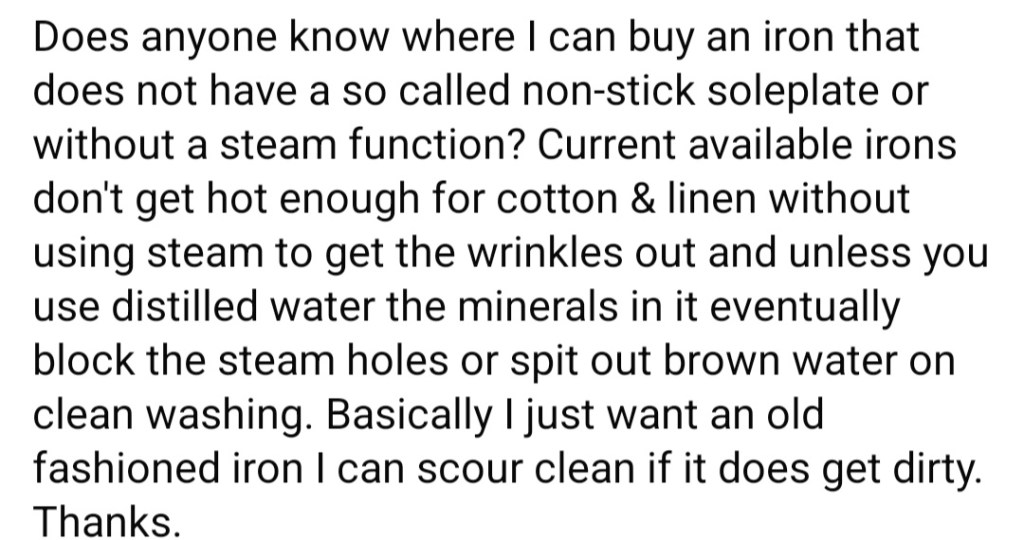
The comments blew up. Thousands of people piling on with their own versions of the same frustration. And honestly? I felt it in my bones.
When Did This Happen?
There was a time — not even that long ago, really — when you could walk into a store, buy an iron, plug it in, and iron your clothes. That was the whole transaction. No special water required. No rubber mat to replace. No companion product to make the thing actually do its job. You just… ironed.
Now? Now you might buy an iron that comes with a rubber base mat you’re supposed to use every single time. That requires distilled water — not tap water, not filtered water, distilled water — or it might damage itself or your clothes. That has settings and modes and maybe even an app to tell you which fabric you’re working with. An iron. A thing that’s been around for over a century. And somehow it’s gotten more complicated.
And it’s not just irons. It’s coffee makers that need special pods and a cleaning solution and a descaling tablet on a rotating schedule. It’s vacuums that need replacement filters and brushes and a docking station and a mobile app to tell you where the dirt is — as if the dirt isn’t going to be wherever you point the thing. It’s printers that refuse to print unless you buy their brand of ink at their price, and even then, they’ll send you a notification that your ink is “low” when there are still pages of life left in the cartridge.
Somewhere along the way, the simple act of buying a product and using it became a relationship. And not the good kind.
The Ecosystem Trap
Here’s what really gets me. It’s not just that these products are complicated. It’s that they’re designed to be incomplete.
You buy Product A, and it works — sort of. But it works best with Product B. And Product B has an accessory, Product C, that extends its life. And oh, you’ll probably want Product D, because without it, Product A is going to start underperforming in about six months. Before you know it, you’ve spent three times what you originally planned, and you’re maintaining a small ecosystem of gadgets just to accomplish something your grandparents did with a single, sturdy machine that lasted twenty years.
That iron someone was looking for? The old one that just worked on tap water without a rubber mat? That was the whole kit. Plug it in. Pick up clothes. Done. No ecosystem. No ongoing costs. No replacement parts on a schedule. Just an iron doing iron things.
This is the ecosystem trap. And it’s not an accident. It’s a business model.
Built to Last vs. Built to Be Replaced
Let me paint a picture. My grandmother had a stand mixer. A simple, heavy, no-frills stand mixer that sat on her kitchen counter for decades. It didn’t have a Bluetooth connection. It didn’t talk to her phone. It mixed things. Cakes, cookies, mashed potatoes — it did it all, and it did it well, and it never once asked for a software update. And I’d bet she had an iron just like it — heavy, simple, reliable, and built to outlast everything else in the house.
Compare that to what’s on shelves today. Products that are sleek and shiny and full of features nobody asked for, but that have a shelf life built right into their design. Parts that wear out just fast enough that you’re looking at replacements within a year or two. Batteries that can’t be swapped out. Components that can’t be repaired because the company doesn’t sell the parts — or worse, doesn’t want you to.
This is planned obsolescence, and it’s been around longer than most people realize. But in the age of “smart” everything, it’s gotten a whole new set of teeth.
The Irony of “Smart” Products
Here’s the real kicker: most of these added features don’t make our lives easier. They make them harder.
A “smart” coffee maker doesn’t save you time if you have to troubleshoot its Wi-Fi connection every other morning. A “smart” vacuum doesn’t make your floors cleaner if you’re spending ten minutes figuring out which cleaning mode to select on the app. A “smart” anything doesn’t feel very smart when it stops working because the company pushed an update that broke something.
And then there are the products that aren’t even “smart” — they’re just needier. An iron that requires distilled water and a rubber base mat isn’t smarter than the ones that came before it. It’s just more dependent. It’s created a maintenance routine where none used to exist. We traded reliability for connectivity. Simplicity for features. And in a lot of cases, we didn’t even ask for the trade.
What We Actually Want
That social media post? The one asking for a simple iron that just does what an iron is supposed to do? It wasn’t a niche complaint. It was a collective exhale. People are tired.
We don’t want our toaster to send us a notification. We don’t want our blender to have a personality. We don’t want to buy distilled water and a replacement rubber mat just to get wrinkles out of a shirt. We don’t want to sign up for a monthly subscription just to use the basic function of something we already paid for.
We want the thing to do the thing. That’s it. That’s the whole ask.
And honestly, there’s something almost radical about that now. Wanting a product to simply work, without drama, without dependencies, without a learning curve — it shouldn’t feel radical. But here we are.
The Good News
Not all hope is lost. There’s a quiet but growing movement toward products that prioritize durability, repairability, and — imagine this — simplicity. Some companies are leaning back into the idea that a well-made, straightforward product is actually a luxury. And consumers are paying attention. The “buy it for life” philosophy has been gaining real traction online, with people hunting down the kinds of no-nonsense, long-lasting products that used to just be… the norm.
It’s a little sad that we have to hunt for them now. But the fact that we’re looking — that we’re actively seeking out the simple, the durable, the just-does-its-job — tells me the tide might be turning. At least a little.
So the next time you’re in the market for a new small appliance, ask yourself: does this thing need an app? Does it need a companion product? Does it need anything other than a power outlet and my willingness to use it?
If the answer is yes to any of those… maybe keep looking. The simple stuff is still out there. We just have to want it enough to find it.

 suchismomlife.blog