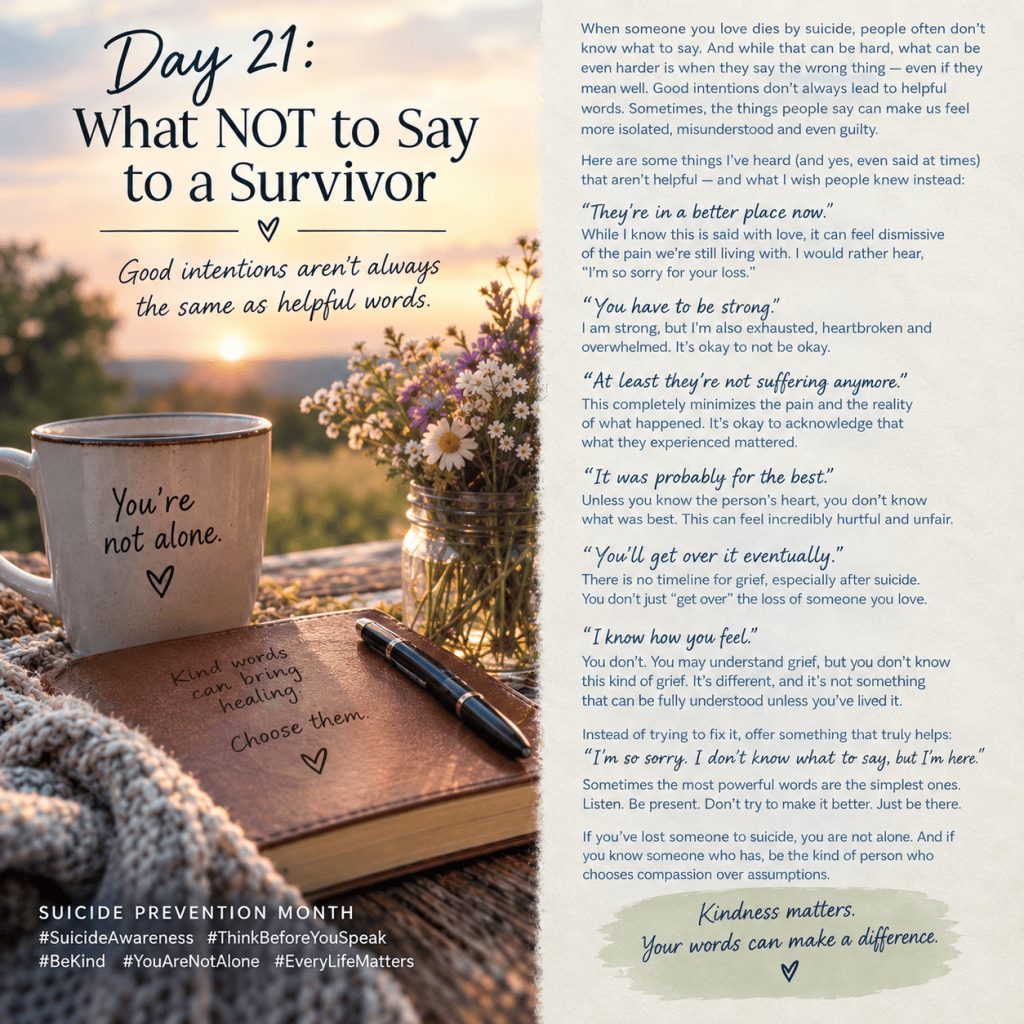
When someone dies by suicide, people often don’t know what to say. I understand that. There isn’t a perfect sentence for a loss like this, and most people who say the wrong thing aren’t trying to hurt anyone. They are uncomfortable. They want to make the pain smaller. They want to find something—anything—that might make the person grieving feel better.
But sometimes the words meant to comfort us actually make the grief harder to carry.
Don’t tell us, “They’re in a better place now.” You may believe that, and your faith may be sincere, but right now we are painfully aware of the place they aren’t. We are living with an empty chair, an unanswered phone call, a birthday that will never be celebrated the way we imagined and a future that suddenly looks different.
Don’t tell us, “You have to be strong.” We may be strong. We may have no choice but to keep getting up, taking care of our families and doing what needs to be done. But strength doesn’t mean we aren’t shattered. Sometimes strength looks like admitting that we aren’t okay.
Don’t tell us, “At least they’re not suffering anymore.” You may be trying to remind us that their pain is over, but it can sound like you’re asking us to find a positive side to losing someone we love. Their pain matters. So does ours.
Don’t tell us, “You’ll get over it.” We aren’t trying to get over them. We are trying to learn how to live in a world where they aren’t here. Those are two very different things.
And please don’t tell us, “I know exactly how you feel.” You may have experienced deep grief, and you may understand what it is like to lose someone you love, but suicide loss has its own complicated layers. There can be grief, anger, guilt, confusion, questions and things you may never fully understand. You don’t have to understand all of it to be there for someone.
I’ve learned that sometimes the best thing you can say is incredibly simple: “I’m so sorry. I don’t know what to say, but I’m here.”
You don’t have to explain why it happened. You don’t have to make sense of it. You don’t have to give us a lesson about life or death. You don’t have to tell us how we should feel or how long we should grieve.
Just sit with us.
Listen when we need to talk about them. Say their name. Let us cry. Let us be angry. Let us remember the good things without immediately bringing the death into the conversation. Understand that some days we’ll seem okay and other days we’ll fall apart over something that doesn’t seem like it should hurt that much.
And please remember this: we lost a person, not a problem.
The person we lost was someone’s child. Someone’s sibling. Someone’s parent. Someone’s friend. Someone’s whole world.
So if you know someone who has lost a loved one to suicide, don’t be afraid of their grief. You don’t have to fix it. You don’t have to understand every part of it. You simply need to be willing to sit beside them in it.
And if you’ve lost someone to suicide, please know that you don’t have to make other people comfortable with your grief. You are allowed to miss them. You are allowed to have questions. You are allowed to have anger right alongside love. You are allowed to have good days without feeling guilty, and terrible days without feeling like you’re going backward.
Sometimes the greatest gift someone can give a grieving person isn’t an answer.
It’s simply presence.
#SuicidePreventionMonth #SuicideAwareness #SuicideLoss #GriefAfterSuicide #SurvivorOfSuicideLoss #MentalHealthAwareness #EveryLifeMatters

 suchismomlife.blog